
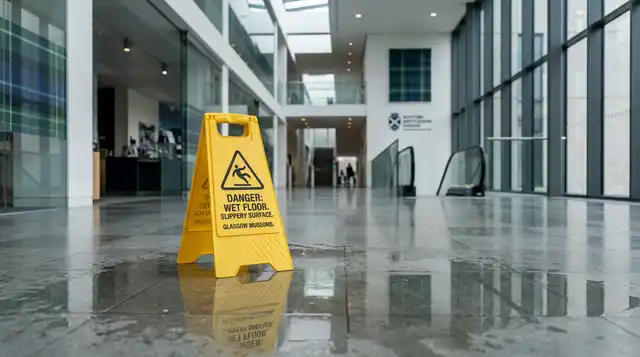
Public Liability Claims in Scotland
If you were injured in a public place or on someone else's premises in Scotland because they didn't take reasonable care, you may be owed compensation. We'll connect you with specialist Scottish solicitors who can take it forward.
Free check · no obligation · no win, no fee
Last reviewed August 2026
What is a public liability claim in Scotland?
A public liability claim in Scotland is a personal injury claim for an accident that happened in a public place or on someone else’s premises — a shop, restaurant, leisure centre, car park, pavement or council-maintained space. If the person or organisation responsible for that place failed to take reasonable care and you were hurt as a result, you may be owed compensation.
The occupier’s duty of care
Anyone who controls premises — an “occupier” — has a legal duty to take reasonable care for the safety of people who use them. This duty is set out in the Occupiers’ Liability (Scotland) Act 1960. In practice it means a supermarket should clean up spillages promptly, a council should maintain its pavements and stairwells, and a restaurant should keep walkways clear. It is not a guarantee that nobody will ever be hurt — the question is whether the occupier acted reasonably in the circumstances.
Common public place accidents
A public liability claim can arise from a wide range of situations, including:
- Slipping on a wet or unmarked floor in a shop or supermarket
- Tripping on a broken pavement, pothole or uneven step
- Being injured by falling stock or poorly maintained fittings
- Accidents at leisure venues, gyms and visitor attractions
Many of these overlap with slips, trips and falls claims. The two often describe the same accident from different angles — “slips, trips and falls” focuses on how you were hurt, while “public liability” focuses on where it happened and who was responsible.
Who the claim is against
A public liability claim is brought against the occupier responsible for the place where you were injured — a business, landlord or public body such as a local authority. In almost all cases the claim is met by their insurer rather than out of anyone’s own pocket, which is one reason it is worth pursuing a genuine claim.
Gathering evidence
Because these accidents often happen quickly and in busy places, good evidence can make a real difference. Where you safely can, it helps to:
- Take photographs of the hazard and the surrounding area
- Report the accident and ask for a copy of the incident report
- Note the names and contact details of any witnesses
- Keep a record of your injuries, treatment and any costs
What you could be owed
Compensation for the injury itself, meaning the pain and its effect on your life, is known in Scots law as solatium. A claim may also cover lost earnings, treatment and care, and out-of-pocket expenses such as travel to appointments. What you could receive depends on your circumstances, as every claim is assessed on its own facts.
Time limits
In most cases you have three years from the date of the accident to bring a claim, under the Prescription and Limitation (Scotland) Act 1973. Some exceptions apply, so if you are unsure it is best to check early rather than risk running out of time. If you’re not sure what to do first, our guide on what to do after an accident walks you through the practical steps.
No win, no fee
Public liability claims are typically funded through a speculative fee agreement — commonly called “no win, no fee” — with QOCS protection under the Civil Litigation (Expenses and Group Proceedings) (Scotland) Act 2018. This usually means you can pursue a claim without taking on the financial risk yourself.
Start your free claim check
If you’ve been injured in a public place and it wasn’t your fault, it costs nothing to find out where you stand. Tell us briefly what happened and we can connect you with specialist Scottish solicitors who handle public liability claims. Starting your free claim check takes only a few minutes.
Not sure if you have a claim? A specialist Scottish solicitor can tell you — free, and with no obligation.
Check if you can claimFrequently asked questions
Who is a public liability claim against?
What's the difference between a public liability claim and a slips, trips and falls claim?
What evidence helps a public place accident claim?
Related
Other claim types
Useful guides
Ready to check your claim?
Use our free, no-obligation claim check and a specialist Scottish solicitor will review your circumstances.
Check if you can claimInjured in Scotland?
Free claim check · no obligation